by: Terry Goodkind
978081254805
List Price: 7.99
 Terry Goodkind's debut 1994 novel in the Sword of Truth series, Wizard's First rule, is a Tolkienian epic fantasy novel that follows the hero's journey of Richard Cypher, a young woods guide in the province of Westland. Westland is separated from the eastern provinces by a magical boundary, allowing the inhabitants of Westland to live a non-magical life. Richard is happy with the course that his life is taking, until one day when everything changes.
One day, as Richard is exploring the woodlands, he happens upon a frightening scene: four large mounted troops are in pursuit of a young woman, Kahlan Amnell. Richard comes to the maiden's aid, subsequently learning that she has somehow crossed the Boundary in search of the First Wizard, who came to Westland during the creation of the boundary.
Richard, not knowing what to do, takes Kahlan to his best friend and mentor, the wise and quirky Zedd. Through Kahlan's perceptiveness, it is discovered that Zedd is not merely an eccentric old man, but is in fact the wizard that Kahlan has been looking for. With that fact revealed, Kahlan confesses the true reason for her quest into Westland; a dark wizard named Darken Rahl has raised an army in attempts to conquer all of the Midlands. Zedd names Richard the Seeker of Truth, bestowing him with the Sword of Truth. Together, the trio begin their journey to stop Darken Rahl's total domination of the Midlands, namely to prevent him from obtaining the Boxes of Orden, which contain the absolute power over life and death.
My Thoughts
 For those who are as addicted to epic fantasy as I am, it is difficult to find a novel that matches up to the level of artistry and mastery of Tolkien's Lord of the Rings trilogy. Yet, Terry Goodkind's Sword of Truth series has yet to disappoint. It encompasses a wonderfully elaborate world with a rich and lavish history and culture that has yet to be rivaled by any other series that I have read.
"Wizard's First Rule" is an interesting combination of epic fantasy, romance, and adventure. The dynamic created between Kahlan (pronounced Kay-len) and Richard as their friendship buds into a romance to rival the greatest of the age is a fascinating and most welcomed element amongst this world of chaos and political upheaval.
The most interesting feature of the world in my opinion is the band of dominatrix torturers known as the Mord Sith. They are an exclusive anti-convent of women who are stolen from their parents at a young age and brutally trained to be ruthless, merciless mercenaries who work on the side of the D'Haran ruler. They are a blend of absolute terror and sexual fantasy, a perfectly deadly combination for those around them.

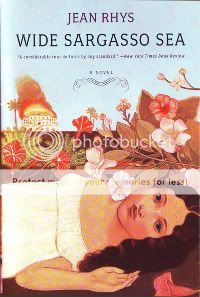 Wide Sargasso Sea is an interesting take on Jane Eyre, although one cannot truly call it a sequel. It is far, far more than that. Wide Sargasso Sea is a novel of the struggle for individuality, repressed sexuality, and the looming threat of psychosis.
 The aspects of this novel that seem most important to me are sexuality and madness. Although I can't claim that the two are mutually exclusive, I can say that Annette's madness had less to do with her sexuality, as some would suggest, and more to do with her oppression under the system of patriarchy.
 Anna is only thirteen and yet she already bears the burden of an age upon her shoulders. She's been through numerous surgeries, procedures, hospitals, and doctor's offices, yet Anna is not sick. She was born to be a genetic match for her sister, Kate, who has leukemia. She offers precisely matched blood and bone marrow to her sister in hopes of keeping her well enough to fight the cancer. Anna has performed her duties lovingly for her sister, until this point in time.
  This book is moving, to say the very least. With so many facets of human emotion displayed so openly in the book, it's hard not to be immediately drawn into the situation. At times, it almost seems as if Kate and Anna are your own sisters or daughters.
  Is it the sweet relief of death or the glorious experiences of life that is man's true desire? Is God a protector who guards his flock of lambs to their ultimate destiny or is he a sinister figure who revels in the pain of those whose existences he controls? Can one truly find perfection within them self?
 This book is one of the most philosophically intriguing pieces of literature that I've come across in the past few years. Luca's struggle through life is particularly fascinating to me. He has no memory of his past, coupled with an urgent need to discover where he came from. He feels incomplete without the knowledge of his lineage, yet also tainted by the nature of the work that had been forced upon him.
 This is the story of little Chiyo, the daughter of a fisherman from Yoroido, Japan. When her mother falls ill, her father sells Chiyo and her sister, Satsu to men from urban Japan. The girls arrive in Kyoto, they are separated; Satsu is sold into prostitution and Chiyo is adopted by a Geisha house as a servant. Hatsumomo, the house's lead geisha, is jealous of Chiyo and constantly torments and belittles her. When young Chiyo becomes depressed with her life, a man called the Chairman, has pity on her and buys her something sweet to eat. Chiyo has never experienced such kindness and is immediately taken by the Chairman's charity. She vows that everything she does will be to bring herself closer to him.
 The most interesting contrast in this book is the role of a prostitute versus that of a geisha. This distinction is one that eludes many foreign minds, especially those who choose not to see the beauty in what a geisha is; an artist.